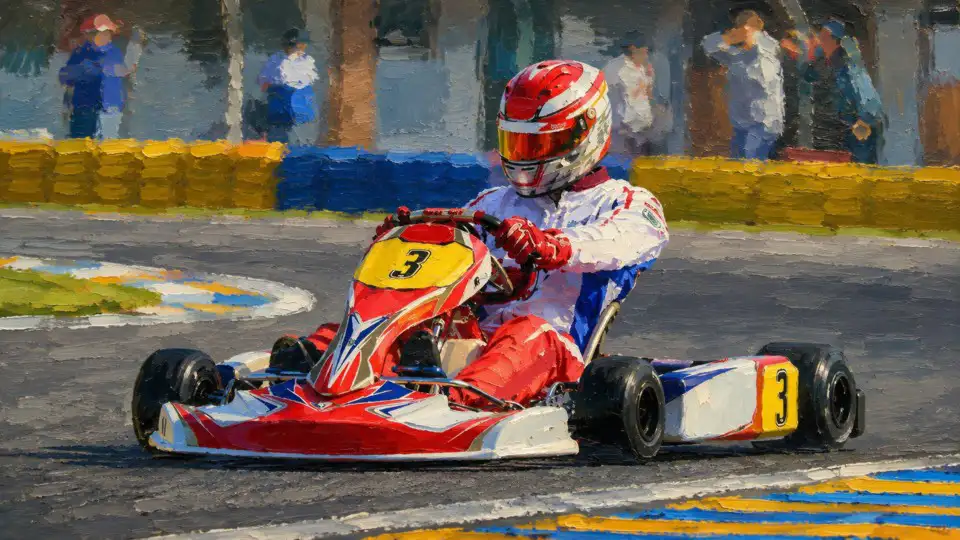
Electric Go-kart
This is a professional electric racing kart built on a sports chassis and designed for competition and intensive track use. Its structure is based on a rigid tubular frame featuring an open layout, plastic bodywork, an adjustable racing seat, a steering column, and a rigid 50 mm diameter rear axle. The front of the chassis connects to independent steering knuckles and the steering mechanism, while the rear houses a drive shaft that transmits torque to the wheels via a 428-series chain drive with a 14/26 gear ratio. The powertrain comprises a 96 V, 56 Ah (5.3 kWh) lithium-ion battery, an electronic controller, and a traction motor; the system's maximum power output is capped at 35 kW. When the pedal is pressed, the controller regulates the current supplied to the motor, which drives the rear axle through the chain transmission. The kart reaches a top speed of 135 km/h and accelerates from 0 to 100 km/h in approximately 3 seconds. Like other racing karts, it lacks a differential and complex multi-link suspension; instead, the rigid frame, low center of gravity, narrow track, and minimal weight ensure immediate steering response and allow frame flex to function as part of the chassis kinematics. The braking system includes both front and rear brakes, and control is handled via a 320 mm diameter steering wheel. The race-ready kart weighs approximately 120 kg. To facilitate intensive racing sessions, a quick-release system allows the battery to be swapped in about one minute.
Model Information
Anton Dubina
In Progress
Car
In Development
TBA