Yak-9T Soviet Fighter (1943)
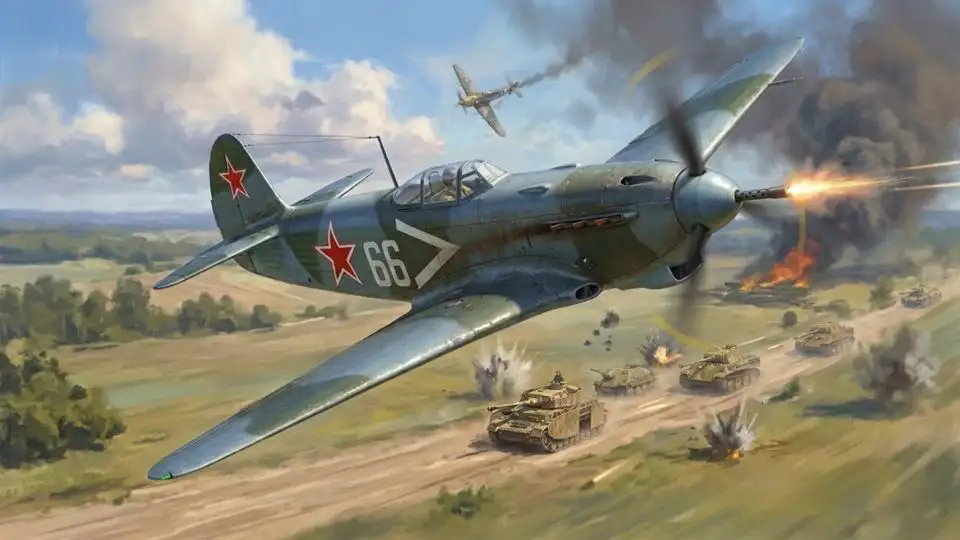
A Soviet single-engine World War II fighter—specifically a cannon-armed variant of the Yak-9 family—that entered mass production in 1943. The aircraft features an all-metal fuselage framework, a mixed-construction design with wooden skinning on certain components, and a low-wing configuration with retractable landing gear. It measures 8.5 m in length, has a wingspan of 9.74 m and a wing area of 17.15 m², and has a normal takeoff weight of 3,000 kg. The nose houses an M-105PF liquid-cooled, 12-cylinder inline engine producing 1,260 hp, which drives a three-blade variable-pitch propeller. A distinctive feature of the Yak-9T is its heavy armament: a 37mm NS-37 automatic cannon is mounted in the cylinder bank "V" and fires through the hollow propeller shaft, while a synchronized 12.7mm UBS machine gun is positioned above the engine. The cannon has an ammunition capacity of 30 rounds, so the airframe is designed for firing short, precise bursts. The armament is located close to the aircraft's longitudinal axis, and the recoil of the 37mm cannon is compensated for by reinforcing specific fuselage elements and the mounting assembly. The cockpit is situated behind the engine and contains an armored seatback and armored glass, an instrument panel, engine and armament controls, a control stick, rudder pedals, and a gunsight. Self-sealing fuel tanks are located in the wings. The main landing gear retracts into bays in the wings and fuselage, and the tailwheel is also retractable. Thanks to its relatively low weight, aerodynamically clean fuselage, and powerful engine, the Yak-9T reaches a speed of 590 km/h and boasts excellent acceleration and maneuverability; however, its defining feature remains the 37mm cannon, designed to destroy aircraft, armored vehicles, and other hardened targets.
Model Information
Anton Dubina
In Progress
Airplane
In Development
TBA