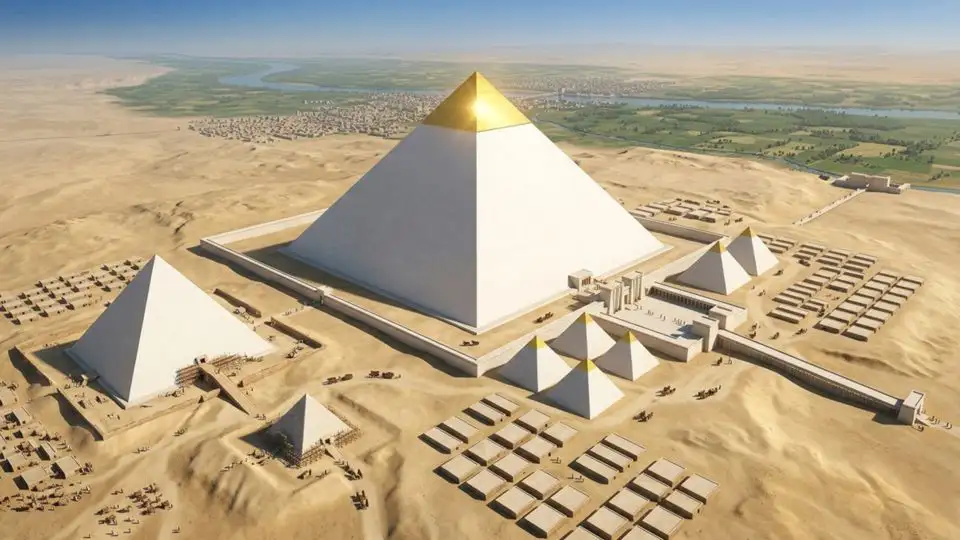
Giza Pyramid (2560 BC)
This is the largest structure in the ancient Egyptian necropolis on the Giza Plateau, erected during the reign of Pharaoh Khufu (Cheops) between approximately 2600 and 2500 BCE. Originally, it stood about 146.6 meters tall with a base side length of roughly 230 meters, and its mass is estimated at several million tons. It rests on a carefully leveled square platform supporting multiple tiers of stone blocks. The bulk of the structure is composed primarily of limestone, while the internal chambers and certain structural elements are made of more durable granite. The exterior was originally clad in precisely fitted blocks of white Tura limestone, forming smooth faces that converged at the apex. Inside the pyramid lies a complex system of passages—including the Grand Gallery, a descending corridor, and an ascending corridor—as well as the Queen's Chamber and the Pharaoh's burial chamber, which is roofed with massive granite slabs. Above Khufu's chamber, relieving spaces are situated, separated by massive stone lintels. The entrance is located on the north side, and the original structure was aligned with high precision to the cardinal points. Construction required the quarrying, transport, lifting, and placement of enormous stone blocks using wooden sledges, ropes, earthen ramps, and a system of work platforms. The complex encompassed not only the pyramid itself but also a temple, a processional causeway leading to it, and a valley temple. The Great Pyramid served as the centerpiece of the royal funerary complex while simultaneously demonstrating the advanced state of ancient Egyptian stone architecture, surveying, labor organization, and engineering. Today, it remains the only surviving wonder of the ancient world.
Model Information
Anton Dubina
In Progress
House
In Development
TBA