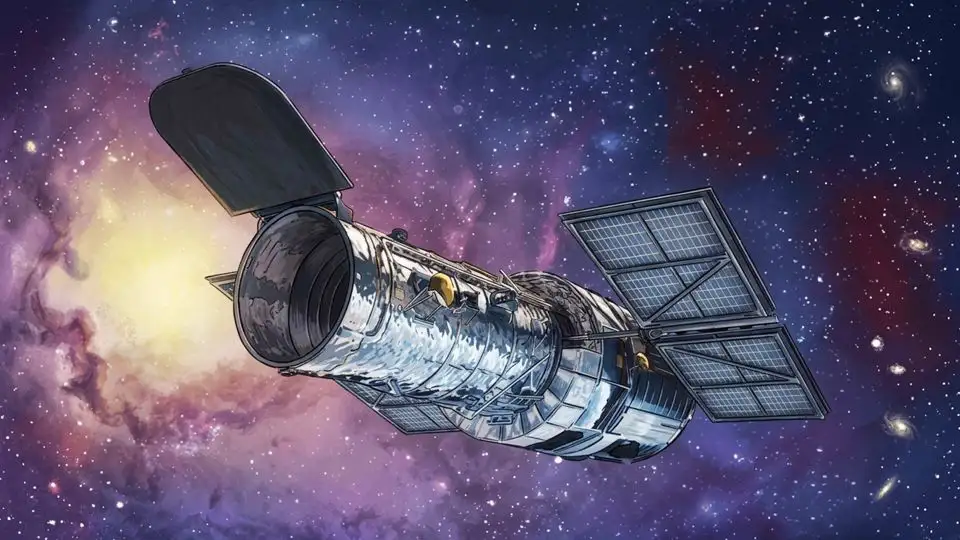
Hubble Space Telescope (1990)
The orbital space telescope is a unique scientific instrument designed to explore deep space, free from the distorting effects of Earth's atmosphere. The spacecraft utilizes a Ritchey-Chrétien optical design and features a robust cylindrical body wrapped in multi-layer silvery thermal insulation, which protects sensitive equipment from extreme temperature fluctuations. Housed within the telescope tube is the primary optical system—comprising a monolithic 2.4-meter primary mirror and a secondary mirror—which focuses incoming light and directs it toward scientific instruments such as spectrographs, fine-guidance sensors, and highly sensitive wide-field cameras. The telescope operates by continuously capturing electromagnetic radiation across the ultraviolet, visible, and near-infrared spectrums. Precise pointing and stabilization are maintained through the use of gyroscopes and reaction wheels rather than thrusters, thereby preventing contamination of the optics. Power for all onboard systems and scientific instruments is supplied by two large, flexible solar arrays mounted on the sides of the spacecraft. Regarding key specifications, the telescope operates in low Earth orbit at an altitude of approximately 530 kilometers, completing a full orbit around the planet in about 95 minutes at a speed of roughly 27,000 km/h. The spacecraft weighs approximately 11 tons and measures over 13 meters in length. Thanks to the absence of atmospheric interference, the system achieves an angular resolution of 0.05 arcseconds, enabling the capture of incredibly detailed images of distant galaxies, nebulae, and exoplanets, making this instrument the ultimate embodiment of history's premier space explorer.
Model Information
Anton Dubina
In Progress
Machine
In Development
TBA